Despite the fact that spring has been on hold here in Chicago, I have been grilling up a storm. There have been pork steaks (my new favorite cut), burgers both meat and vegetarian, and lots and lots of chicken. There is a good reason that chicken is America’s favorite meat (uhh, have you ever had crispy chicken skin?), and with the help of this marinade, I think it is going to stay that way for a long time.
Juicy Lucy
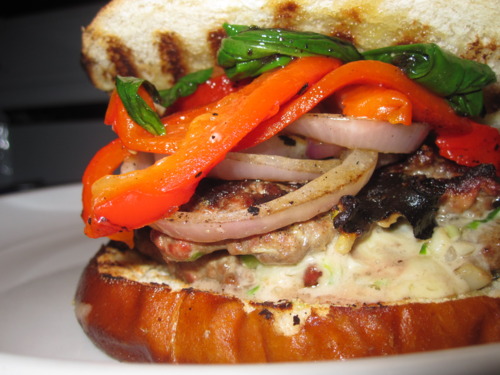
I went for afternoon cocktails with my friend Brad yesterday, fully intending to have a few martinis and then move on to one of Chicago’s many fine restaurants for dinner. Brad had just returned from a long weekend in Minneapolis with his family, where they had traveled the city eating a variety of hamburgers stuffed with cheese. This concept is apparently run-of-the-mill in Minneapolis, where everything is magical and stuffed with cheese. Realizing that what my life had been missing was almost certainly this very stuffed burger experience, I talked Brad into skipping the pricey restaurant and hitting a few great neighborhood shops to create our own signature Juicy Lucy’s on my patio grill.
Dude, Let’s Make a Pizza
When my brother and I were little, we dreaded homemade pizza night. Aside from the fact that we weren’t allowed to run around like banshees and chug pitchers of root beer like we would have at the pizza parlour, homemade pizza protocol in the 80’s was just pitiful by today’s standards. The dough came from a mix and was much too soft for a nice, thin crust pizza. Vegetables were thrown on raw, causing them to release water when cooked and compromise the already craptacular crust.
Fortunately for us, great pizza has come into fashion, which means that the information and tools to make great pizza are more readily available. Once you know a few basics, making your own pizza is infinitely more rewarding than ordering one, if you like to make pizza as well, read this post on what is brooklyn-style pizza. And you’ll only get better and better at it the more you do it.
Nothing Beats a Sunday Casserole
There are so many ways to make a great casserole. There’s the cream of mushroom soup/tater tots/frozen broccoli variety (magical in its own way), and then there are the more hard-won varieties. This week, I made a Hunter’s Stew (aka Chicken Cacciatore) with mushrooms, olives, tomatoes and roasted peppers. I then topped it with cheesy polenta and let it let reduce and bubble in the oven. It took the better part of the afternoon, but it was so, so worth it.
Fesenjan
The first time I had this dish it was prepared by a co-worker for a class at the cooking school where we worked. I had been teaching a different class that night, and once all the students left and it was time to relax, have a bite to eat, and clean up, all that was left of her delicious Fesenjan was the chicken fat-rich gravy laced with ground walnuts and a few pomegranate seeds. We were both starving and so we split the dregs between us, eating them with the crusty basmati rice that was left stuck to the pot. Needless to say, even the remnants of the meal were delectable.
This time around, I used flavorful wild rice as a base and lightened the dish ever so slightly by substituting pomegranate juice for the pomegranate molasses. While this molasses is a wonderfully flavorful ingredient, it can be hard to find, even in Chicago! The pom juice is not only lower in sugar, but as the dish simmers, it reduces to become more concentrated in flavor, much like the syrup itself.
For the Fesenjan:
4 bone-in, skin-on chicken legs and thighs, washed, patted dry, and seasoned with S & P
Olive oil
1 large or 2 small white onions, thinly sliced
2 C. pure pomegranate juice (Lakewood and Pom brands seem easy to find)
5 cardamom pods
1 tsp. cinnamon or 1 cinnamon stick
1 1/2 C. walnuts, chopped finely by hand or in a food processor
1 large, firm eggplant OR 10-15 small Indian or Thai eggplants, cut into large pieces
Chicken broth (1 box is ample)
Seeds of 1 pomegranate for garnish
Chopped fresh parsley or cilantro for garnish
Wild Rice
Start by heating a wide pan, large enough to hold all 4 pieces of chicken in a single layer, over medium high heat. Add the oil and swirl, then place the seasoned chicken pieces, skin side down, in the oil. Let brown thoroughly on the skin side, turning only when they are easily released from the pan and quite brown. Treat the other side in the same way, and then remove the chicken from the pan and set aside.
Add the onion to the same pan and season with S & P. Saute for 5-10 minutes, until golden brown. (Some bits may be stuck to the bottom of the pan, but this is what you want….just don’t let them burn) Deglaze the pan with the pomegranate juice and stir, scraping up any browned bits from the bottom of the pan. Add the cardamom and cinnamon. Let the liquid come to a strong simmer and reduce for a few minutes, until thickened. Place the browned chicken back into the pan in a single layer, nestling it down into the onions. Pour the chicken broth in until it reaches up the sides of the chicken about 2/3 of the way (this will vary considerably depending on the size of your pan). Sprinkle with the walnuts, cover, and simmer over medium-low heat for 25-30 minutes. Start a pot of rice at this time to serve with the Fesenjan. After 30 minutes, uncover the chicken and turn each piece over, again nestling them down in the liquid.
Add the eggplant at this time and cover again for another 25-30 minutes. Once the cooking of the second side is complete, remove the chicken from the pan and set aside. Increase the heat under the remaining liquid to medium high and simmer for 5-8 minutes, stirring regularly, until sauce has reduced and the eggplant is quite soft. Season sauce to taste with salt and pepper. Serve chicken over a mound of rice, topped with several generous spoonfuls of sauce, and garnished with pomegranate seeds and fresh herbs.
Whole Wheat Stollen
I spent last Christmas in Wisconsin with my boyfriend’s family, and of all the wonderful things we cooked and ate, the hands-down winner in my book was a Stollen from a bakery in Lodi, WI. The dough was soft and challah-like, the marzipan center generous, and the pecan and candied cherry-studded icing irresistibly sweet. Unfortunately, the Stollen was so irresistible that between the 5 of us, we managed to polish off 2 whole loaves in under 2 days.
Don’t get me wrong, I believe fully in the satisfaction that only accompanies a taste of the “real thing”, but the combination of guilt and skyrocketing blood sugar, not to mention the hangover from the warm whiskeys fortified with “Tom and Jerry” mix left me feeling a bit blue post-holiday.
This year, I have resolved to build a new and improved Stollen. Packed with dried organic cherries and Himalayan Hunza Raisins, this primarily whole wheat loaf will leave you happy, healthy, and satisfied this holiday season. Even if you eat the entire thing.
Whole Wheat Stollen
For the fruit:
2 C. dried fruit of your choice. Try cherries, raisins, apricots, currants, or pineapple. If necessary, cut into bite-sized pieces.
1/2 C. brandy, cognac, or wine of your choice
Juice of one organic orange (you will need to zest this very orange shortly, so be gentle)
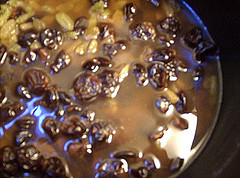
Bring the alcohol and orange juice to a simmer in a small saucepan and add the dried fruit. Stir together and set aside, covered, to steep.
For the sponge:
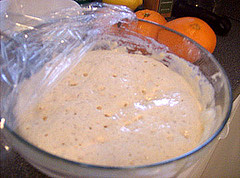
Heat 3/4 C. nonfat milk in a small saucepan over low heat to around 110 degrees (think hot tub temperature). Pour into a large bowl and sprinkle in 2 packets of yeast. Stir together thoroughly and then add 1/2 C. unbleached flour. Stir everything together until well combined, cover with plastic wrap or a kitchen towel and place in a warm spot for about an hour. I heat my oven to 250 degrees and set the bowl on top of the oven, which seems to work fantastically. When ready, the sponge will have tripled in volume and should look quite foamy.
Next, add the following ingredients to the sponge mixture:
2 C. whole wheat flour
1/3 C. organic sugar (evaporated cane juice)
1/2 stick soft butter
2 eggs
1/2 tsp. salt
2 tsp. cinnamon
Zest of one organic lemon and one organic orange
3/4 C. chopped nuts (I used walnuts, but almonds, pecan, and hazelnuts are good choices, too)
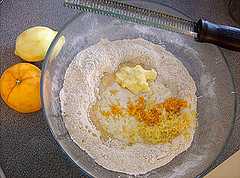
Mix these ingredients together thoroughly using a wooden spoon until they form a ball. The dough should be moist, so if it seems dry, add a few more tablespoons or milk or water. Next, drain any extra liquid from the cherry and raisin mixture and stir in the soaked fruit. I use my hands to mix at this point, folding the dough over the fruit and nuts until they are mostly incorporated.
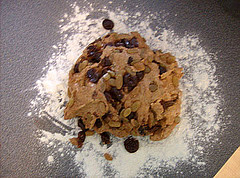
Now that you have made your dough, turn it out of the bowl onto a lightly floured surface and knead it for 10 minutes until it becomes less “shaggy” and more “smooth” (see photos below). Next, return to the bowl (which you should grease with a bit of vegetable oil or butter), cover again with plastic or a towel, and return to the warm spot for 1-1/2 hours, until doubled in volume.
While the dough rises, prepare the almond filling. In the food processor, combine 1 C. raw almonds with 2 Tbsp. organic sugar, 2 Tbsp. water, and 1 tsp. cinnamon. Run processor until it forms a paste. Alternatively, you can use 3/4 C. purchased almond butter and mix it with the sugar and cinnamon (no water is necessary).
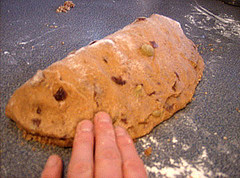
Once the dough has risen adequately, turn it out of the bowl onto a sprinkling of flour and divide in 2 equal pieces. Pat each piece out into a roughly rectangular shape, approximately 10 by 5 inches. Brush each rectangle with an egg wash (1 egg mixed with 1 Tbsp. water) to help the almond filling stick to the dough. Sprinkle 1/2 of the almond mixture in the center of each rectangle. Spread out gently, leaving a 1 inch border of egg wash on all 4 sides. Fold the rectangle in half by pulling one 10 inch side toward the other and push the edges together to seal (see picture). The shape will be more like a crescent (think calzone).
Prepare a baking sheet by lining it with parchment or wax paper. Transfer the filled dough to the sheet, placing them seam side down and at least 3 inches apart (they will need room to rise again). Brush with remaining egg wash. Preheat your oven to 400 degrees and set the stollen on the stovetop, covered with a damp towel, for 30-45 minutes more until slightly risen and puffy (this rising will go fast because your oven will be much warmer).
When risen, place in the 400 degree oven for 15 minutes, then reduce heat to 350 degrees and bake for 25-35 minutes longer, until well browned and cooked through (the toothpick test seems to work well).
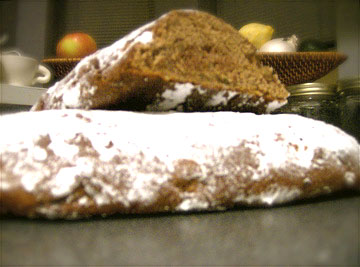
Cool the loaves for a minimum of 2 hours, and then place each loaf in its own large plastic bag or tupperware container and sprinkle into each 1/2 C. powdered sugar. Gently shake the closed bag or container to coat the loaf. Let the loaf rest and hour and shake again, adding more powdered sugar if necessary or intriguing. The longer the loaves “rest” in between sugarings, the more moist their surfaces will become and therefore the more sugar they will take up.
To serve, slice the Stollen about 1 inch thick and microwave for 20-30 seconds. You can also toast the slices, but they stay more moist in the microwave. Plus, I’m a risk-taker. Spread with a little butter if you like and serve with coffee or tea.
The stollen will keep on the counter in a sealed container or bag, for at least one week. In the fridge, they should last up to 3 weeks. We ate one loaf throughout the week and froze the other.




RSS - Posts